Historical Heritage
Old town and immediate vicinity
Since the Kamakura period, the community of Miyajima has been gradually developing, and there is an atmosphere of subtle simplicity in daily life unique to Miyajima. There are excellent old fashioned techniques used in the building structures, unheard of historical monuments and legends, and a touch of the islander’s lives on the island. Please take your time to explore the area.
Machiya-Dori

Machiya-dori
After it was reclaimed in the beginning of the Edo period, Machiya Dori used to be called Honmachi Suji, and it was the main street during the most prosperous era in Miyamina.
‘Itsukushima Zue’ illustrations show a place where drunken men walk around happily along the street where stores and inns stood in a row.
After the war, during the Showa period, entertainment venues such as a movie theater and coffee shops disappeared, and tourists flocked to the Omotesando shopping area, which had become the economic lifeline of the people who lived there.
The old Machiya architecture was gaining attention after the ‘Miyajima Hina Doll Exhibition’ started in 2001.
Since then, the area has been called Machiya Dori, and stylish modern inns and art galleries with traditional style machiya architecture have been built.
At night, the lanterns are lit at the edge of the eaves, which gives it a different atmosphere from day time.
The attraction of Machiya Dori comes from its long lasting history and from the people who live in the area.
Seishin Tsurui

Seishintsurui
At the end of the Edo period, the priest Seisin is said to have dug 10 wells on the island for the islanders who suffered from thirst. Four of them are still preserved.
Seishin also worked for the improvement of roads and for manufacturing the rice scoops(Shakushi) which later became one of the most famous Miyajima handicrafts. Because of his virtue, a monument in his image was built by Komyoin temple.
Yamabe Alley

Yamabe-no-komichi
When the current Omotesando was still under the sea, Yamabe Alley was the oldest path to the shrine for visitors.
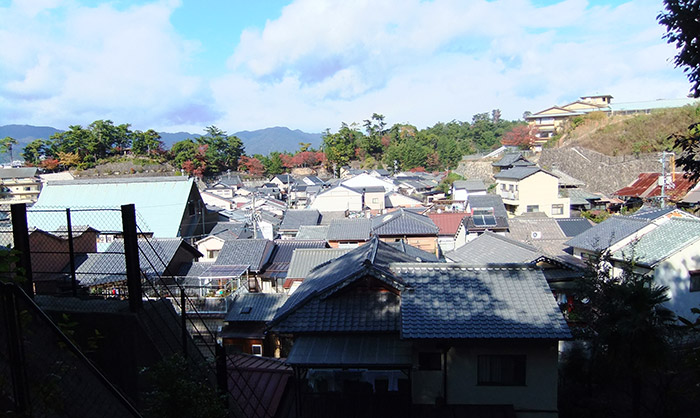
The alley starts at Hill Yogai and goes up to where there is a spot to view the great Torii, which is colored with vermilion, the 5 storied pagoda, and the waves of tiled roofs in the residential area.

Kakurenbo back street
Taki-no-kōji

Taki-no-kōji Alley
Taki-no-koji (dead end street) used to be for the household of staff working for Itsukushima Shrine. The hillside path has a gentle incline from Itsukushima shrine to Daisho-in. There were residents of high officials and their families, the maid of honor of Itsukushima shrine, and the guesthouses of Daishoin. Even today, there are dormitory houses for the Shinto staff of the Taki-no-koji.
Unique houses with lattices of vertical timber bars on the facades can still be seen, and the stillness of Taki-no-koji is very different from the main street with its souvenir shops.
In the morning, you can hear the sound of wooden clogs as the Shinto staff walk towards the Shrine.
Gods Everywhere on the Streets

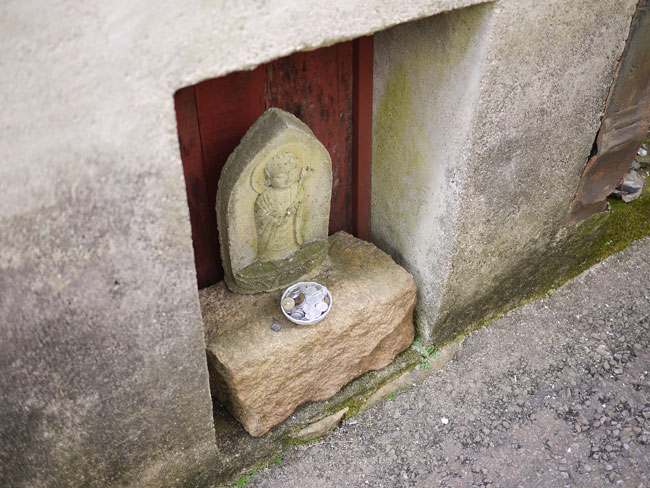
Enmei Jizo
While walking on the island, you will come across various small shrines or Jizos. Each of them has their own origin and history. They will make you realize that this is truly an island of the gods.
1. Nagahama Shrine, where its torii floats on the sea just like Itsukushima Shrine.
2. Saiwai Shrine where they hold a big festival on August 15th (by the old calender) every year. It is known to house the god of matchmaking.
3. Awashima Shrine is the protective god of women. It is visited when girls on the island have their first menstrual period.
4. Shinomiya Shrine is in Momijidani Park, where the event ‘Tanomosan’ is held.
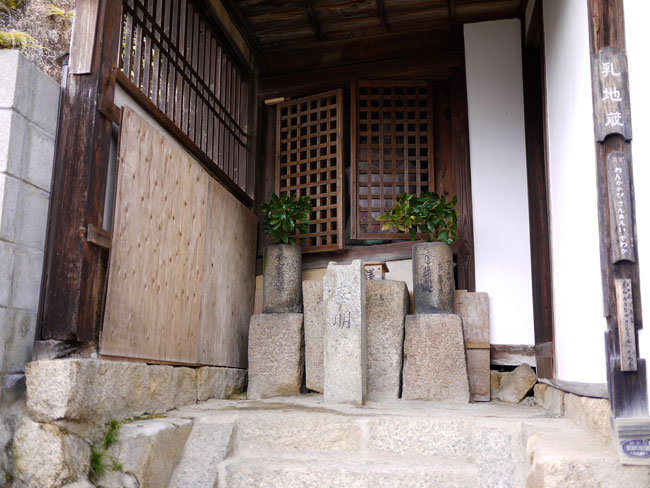
5. The name of the hill, Nyoninzaka came from the female relief of statues there.
6. Chichi Jizo on Nyoninzaka on the Yamabe no Komichi. Mothers who pray here are ensured successful breast feeding.
7. Enmei Jizo or the ‘Ojizo San of Sakura Machi’ is a familiar name. It is along Yamabe No Komichi.
8. Fudoin was built to protect the demon’s gate of Itsukushima Shrine.